Mastering how to decline an interview is an essential art form that separates the merely ambitious from true career visionaries who protect their inner peace and professional integrity. When an unexpected fork in the road appears, candidates often find themselves wrestling with a silent storm of conflicting emotions, questioning whether walking away will burn vital bridges or spark a new era of professional respect.
Recent developments in the modern job market highlight a growing shift toward absolute transparency, where professionals increasingly realize that saying no to the wrong opportunity is the ultimate catalyst for discovering the right one. Stepping back from a potential career trajectory requires a delicate balance of warm appreciation and firm detachment, ensuring that your reputation remains pristine while you bravely protect your time, energy, and core values from environments that simply do not align with your future.
Navigating the Emotional Terrain of Walking Away from Career Opportunities
The moment a professional decides to pivot away from a prospective employer after months of enthusiastic dialogue often triggers a profound internal tempest. This subtle yet heavy emotional landscape involves balancing gratitude for a prospective team’s time with the daunting realization that the destination is no longer right, transforming a standard career decision into an exercise in psychological endurance.
Stepping back from a hiring manager requires navigating a complex labyrinth of cognitive dissonance. Job seekers often invest heavily in the mental projection of a future role, visualizing desk setups, team dynamics, and professional milestones long before an offer materializes. When that projected reality shatters due to new insights—such as a misalignment in company culture or unexpected compensation ceilings—the brain processes the withdrawal as a tangible loss rather than a strategic redirection.
This phenomenon is deeply rooted in the endowment effect, where candidates overvalue the potential prestige or security of an impending offer simply because they have mentally claimed it. Furthermore, the anxiety of disappointing a hiring authority who has advocated for the candidate creates an acute sense of social debt. Professionals frequently overestimate the negative impact of their declination on the recruiter’s well-being, projecting personal guilt onto a corporate entity that routinely manages talent pipelines and candidate attrition.
Declining an interview gracefully requires honesty and respect for your future path. Just as unexpected hurdles demand a prompt calling out of work sick email to protect workplace trust, politely stepping back from an opportunity preserves your professional reputation. Master this delicate pivot today, and you will open doors to better moments tomorrow.
This emotional tax is amplified by the lingering fear of the unknown, forcing individuals to weigh the immediate comfort of closure against the lingering whisper of professional regret.
The Hidden Costs of Cultural Misalignment
Accepting a position that fundamentally contradicts an individual’s core values introduces a slow-burning form of burnout that outlasts any short-term financial gain. According to workplace psychology research from organizations like Gallup, chronic value misalignment is a primary driver of disengagement, manifesting physically through elevated cortisol levels, disrupted sleep patterns, and a pervasive sense of dread on Sunday evenings. When professionals compromise their ethical boundaries, collaborative preferences, or autonomy to secure employment, they enter a silent contract of compromise that erodes self-efficacy over time.
Consider the real-world trajectory of mid-level executives who accept high-paying roles in rigid, top-down bureaucratic environments despite thriving previously in agile, innovative ecosystems. Within six months, data consistently shows a sharp decline in productivity, accompanied by emotional exhaustion and a tarnished internal brand, as the daily friction of working against one’s grain drains the cognitive reserves needed for strategic problem-solving.
The true cost, therefore, extends far beyond mere job dissatisfaction; it consumes the precious currency of mental health and stalls authentic professional growth, proving that a misaligned paycheck is ultimately a deficit.
Protecting your long-term professional resilience requires recognizing that saying no to the wrong environment is the ultimate affirmation of your core value.
Stepping back from a career opportunity requires grace, much like practicing best exercises for personal growth to strengthen your inner resilience and daily focus. When you respectfully decline an interview, you protect your professional boundaries while keeping future doors wide open for new, perfectly aligned adventures.
Psychological Frameworks for Overcoming Recruiter Apprehension
Reframing the act of declining an offer demands mental models that shift the focus from perceived rejection to objective alignment. These structured approaches empower candidates to communicate their decisions with clarity, empathy, and unyielding professional grace.
Stepping back from a career opportunity requires grace, yet refocusing your professional trajectory can be powerfully guided by writing goals within a manifesting journal to clarify your true path. Mastering how to decline an interview with polite firmness ultimately opens the door for better alignment.
- Decoupling self-worth from external approval involves separating your inherent professional value from the temporary disappointment a hiring manager might feel, allowing you to act as an objective evaluator of mutual fit rather than a pleaser seeking validation.
- Applying opportunity cost analysis shifts your mental math toward the future, reminding you that every hour spent in a misaligned role is an hour stolen from pursuing opportunities that genuinely amplify your strengths and career trajectory.
- Adopting the stakeholder perspective helps you realize that corporate recruiters prioritize efficiency and long-term retention over personal attachment, meaning a timely and honest declination is actually a professional courtesy that saves the company from a costly mis-hire.
Warning Signs of an Energy-Draining Workplace
Discerning the subtle cues of a toxic or depleting organizational culture during the interview process requires acute observational skills. Candidates must look past polished employer branding to identify structural red flags that signal inevitable workplace friction.
- Interviewer fatigue and disorganization manifest when hiring managers repeatedly reschedule meetings, arrive unprepared, or display visible tension, reflecting systemic overwork and poor internal communication.
- Vague definitions of success become apparent when leadership fails to provide clear metrics for the role, relying instead on buzzwords like ‘wearing many hats’ or ‘hustle culture’ to disguise chronic understaffing and boundary erosion.
- Defensiveness during cultural inquiries occurs when questions regarding work-life balance, employee turnover, or management styles are met with evasive answers or subtle irritation rather than transparent dialogue.
- Inconsistent communication protocols emerge early when HR representatives provide conflicting details about compensation, remote work policies, or onboarding timelines, forecasting administrative chaos once you are on the payroll.
Crafting a message that closes the door gracefully requires a delicate balance of warmth and professional detachment.
In the high-stakes arena of modern commerce, the digital trail we leave behind carries immense weight, functioning as a permanent digital tattoo that can either elevate our professional standing or quietly erode it. When an employment pursuit reaches a definitive crossroads, the electronic correspondence dispatched to the hiring team acts as a final brushstroke on the canvas of your professional reputation.
Masterfully drafting this final communication demands an acute awareness of industry perceptions, where news travels swiftly across interconnected networks and recruitment circles whisper long memories. Striking the precise equilibrium between heartfelt appreciation and firm professional boundary-setting ensures that bridges remain intact without inviting awkward counter-offers or prolonged persuasion attempts.
Constructing a digital correspondence that preserves your reputation within a specialized industry requires a meticulous architectural approach to written communication, blending diplomacy with unyielding clarity. The digital canvas before you must first open with a genuine acknowledgment of the time, energy, and intellectual capital invested by the hiring committee throughout the evaluation cycle. Industry veterans understand that recruitment teams operate under intense pressure, often managing dozens of competing priorities, making a personalized expression of gratitude not merely polite, but strategically vital for long-term networking capital.
Following this initial appreciation, the pivot toward declination must be executed with surgical precision, avoiding vague excuses or elaborate personal justifications that invite interrogation. By offering a concise, unambiguous statement regarding your decision to pursue alternative directions, you establish a commanding presence that signals maturity and decisiveness. The language deployed should consistently project calm authority, steering entirely clear of defensive posturing or apologetic over-elaboration.
Furthermore, concluding the missive with a forward-looking statement regarding future industry intersections transforms a rejection into a display of mutual respect. This careful calibration ensures that executives and talent acquisition specialists file your name away not as an applicant who slipped through the fingers, but as a formidable professional who handles career transitions with consummate grace and unwavering integrity.
Anatomy of a Professional Declination
Decoding the psychological mechanics behind a graceful exit involves understanding how hiring managers process rejection and how specific structural components of your message influence their perception. The following breakdown maps the essential layers of a refusal message alongside their underlying cognitive impacts and actionable execution strategies.
Stepping back from a career conversation requires grace, yet sometimes momentum stalls before new doors open. When your professional journey demands a fresh spark, knowing how to activate it changes everything. By resetting your inner drive with bold clarity, you can respectfully decline an interview today while confidently preparing to embrace the right opportunity tomorrow.
| Anatomy of the Message | Underlying Psychological Effect | Practical Application Tip |
|---|---|---|
| Contextual Appreciation | Validates the hiring team’s extensive effort, diffusing the potential sting of rejection and preserving relational equity. | Reference a specific, meaningful discussion from the interview rounds to demonstrate genuine engagement. |
| Decisive Pivot | Signals unwavering clarity and professional agency, preventing the recipient from misinterpreting the message as a negotiation tactic. | State the decision plainly without relying on exhaustive personal excuses or ambiguous scheduling conflicts. |
| Forward-Looking Close | Frames the departure as a mutual alignment of paths rather than a severed connection, fostering enduring industry goodwill. | Express enthusiasm for the organization’s future milestones while firmly closing the current application chapter. |
Definitive Phrasing for Final Decisions
Executing a decisive exit requires specific linguistic formulas that communicate gratitude while erecting an impenetrable barrier against counter-offers. Utilizing direct, unambiguous sentence structures ensures that talent acquisition professionals immediately recognize the finality of the correspondence, thereby averting any prolonged, uncomfortable back-and-forth dialogue.
- Express sincere appreciation for the opportunity while explicitly stating that you are withdrawing from consideration for the specific role.
- Deploy definitive terminology such as concluding the process rather than exploring current availability, which signals a closed loop.
- Avoid open-ended inquiries regarding future openings unless a genuine, long-term alignment exists within your immediate strategic roadmap.
Visualizing the ideal digital correspondence reveals a minimalist yet warm layout, devoid of clutter, where paragraphs remain concise and purposeful. Picture a clean, high-contrast digital interface displaying typography that exudes understated elegance, accompanied by a signature block that quietly reinforces your standing as an industry authority. The visual weight of the message rests entirely on its structural balance—equal parts appreciative and resolute—mirroring the poise of a seasoned professional stepping smoothly into their next major enterprise.
“Thank you once again for the opportunity to explore the intricacies of your upcoming initiatives and for the tremendous generosity of your team’s time. After deep reflection on my long-term professional trajectory, I am writing to withdraw my candidacy for the role, as I have chosen to pursue an alternative path that closely aligns with my current strategic focus. I deeply admire your organizational vision and wish you resounding success as you secure the ideal candidate for this pivotal chapter.”
The timing of your withdrawal dramatically alters how the hiring team perceives your professionalism and respect for their internal schedules.

Source: zippia.com
Every tick of the office clock echoes through the corridors of corporate recruitment, where calendars are carefully choreographed puzzles of executive availability and human resource bandwidth. When a candidate steps backward in the recruitment timeline, the precise moment of their departure sends shockwaves through the department, permanently etching an impression of either mindful consideration or careless disregard upon the minds of the hiring managers.
Mastering the art of the exit requires navigating these temporal currents with surgical precision, ensuring that the parting of ways leaves the soil fertile for future professional cultivation rather than scorched by sudden abandonment.
Strategic timing operates on a distinct rhythm within the modern corporate ecosystem, where pulling your name from consideration requires foresight akin to a chess grandmaster protecting their pieces. Announcing your departure early in the cycle transforms a potentially disruptive inconvenience into a manageable pivot for the recruitment panel. When you withdraw at least a full week before the scheduled encounter, you gift the talent acquisition team a precious commodity: adaptation space.
This generous window allows coordinators to gracefully reallocate interview slots, inform waiting runners-up, and adjust the evaluation matrix without incurring costly overtime or cascading scheduling delays. Conversely, dropping out a mere twenty-four hours before the appointed hour shatters the delicate architecture of the hiring manager’s week. That eleventh-hour retreat leaves empty chair-legs staring at a panel of executives who have carved precious hours from critical project deadlines, breeding silent resentment that permanently tarnishes your professional reputation within that organization’s ecosystem.
Respecting the calendar of a hiring team is the ultimate currency of corporate grace; spending it wisely ensures your professional credit remains inexhaustible.
Emergency protocols for sudden life disruptions
Unforeseen crises do not consult corporate calendars, and when catastrophic personal emergencies strike, the rigid rules of advance notice must bend to the harsh realities of human existence. Activating an emergency protocol requires absolute transparency coupled with immediate, concise communication the moment stability returns, acknowledging the disruption without oversharing intimate details. A brief, respectful dispatch explaining that an acute personal crisis demands your undivided attention prevents the silent ghosting that permanently blacklists candidates from future organizational rosters.
The administrative chaos unleashed when a candidate vanishes without a trace leaves talent acquisition professionals drowning in a sea of logistical nightmares and broken workflows. Hiring coordinators face a cascade of systemic failures that ripple outward across multiple departments when an interview ghost walks away from the process.
- Panels of senior executives sit in empty conference rooms, watching minutes tick away while valuable strategic planning time evaporates into thin air.
- Automated applicant tracking systems flag the sudden vacancy as an anomaly, freezing pipeline analytics and throwing recruitment metrics completely out of alignment.
- Candidate communication sequences misfire, accidentally sending automated follow-up praise to a ghost while missing the opportunity to pivot toward viable alternatives.
- Budgetary resources allocated for travel reimbursements, hospitality arrangements, and background check clearances are abruptly locked in administrative limbo.
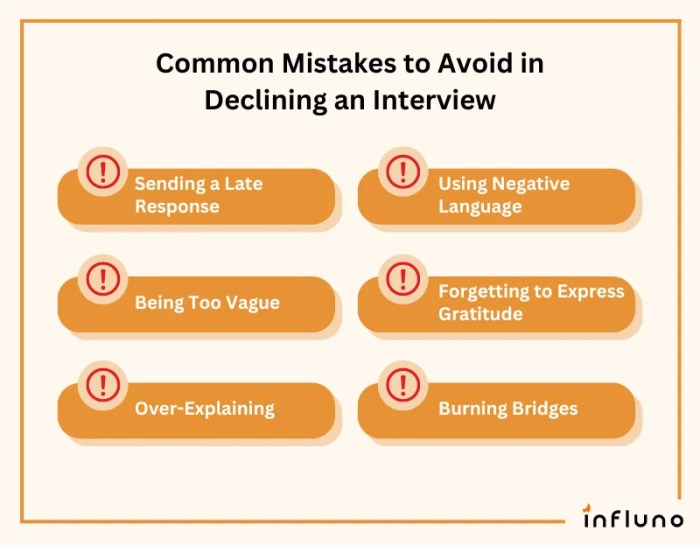
Protecting your professional network relies heavily on leaving a lasting impression of integrity even as you exit the talent pipeline.
Source: influno.com
Stepping away from a prospective employer does not mean the end of a professional narrative; rather, it often marks the quiet commencement of a more enduring alliance. When candidates handle their exit with poise, they plant the seeds for future collaborations that frequently surpass the initial job offer in value. This delicate transition requires an acute awareness of personal brand management and a genuine appreciation for the time invested by the hiring team.
Transforming a rejected offer into a lifelong mentor relationship with the hiring executive demands a shift from transactional communication to relational investment. Executive leaders rarely encounter candidates who gracefully decline an opportunity while simultaneously offering to champion the company’s broader mission. By acknowledging the specific insights gained during the interview process, you validate the executive’s leadership and the organization’s strategic vision.
A thoughtful follow-up message should express deep gratitude for the mentorship implicitly provided during the evaluation stages, framing the dialogue not as a closure, but as a graduation to a peer-to-peer advisory dynamic. Proposing a future coffee meeting or a periodic check-in regarding industry trends transforms a temporary recruiter-candidate hierarchy into a sustainable, mutually enriching professional friendship. Industry veterans often note that leaders remember those who walked away with grace far more vividly than those who accepted out of obligation, frequently calling upon these principled individuals for board advisement or strategic partnerships years down the road.
Peer Recommendation Strategies for Vacated Opportunities
The subtle art of recommending a talented peer as an immediate replacement for the vacancy you are vacating acts as a powerful buffer against the disappointment of your departure. Instead of leaving the hiring manager scrambling to restart their search, you step into the role of a trusted talent scout, effectively solving their immediate operational dilemma. This gesture requires precise calibration to ensure the recommended peer matches both the technical requirements and the cultural nuances of the organization.
Delivering this recommendation involves a warm, detailed introduction that highlights the peer’s specific achievements without overshadowing your own reasons for stepping aside.
Navigating this handoff successfully involves several precise actions that protect your reputation while championing your colleague.
- Assess the peer’s current professional availability and genuine interest in the specific scope of the vacant role before initiating any formal introduction to the hiring manager.
- Draft a concise, compelling endorsement memo that explicitly connects the peer’s proven track record with the strategic pain points discussed during your own interview rounds.
- Obtain explicit consent from both parties, ensuring the hiring manager welcomes the referral and the peer is fully prepared to enter an accelerated interview pipeline.
- Follow up gently with the hiring manager to reiterate your confidence in the referral, while stepping back entirely to allow the peer to build their own unencumbered relationship.
Leaving a talent pipeline with absolute transparency acts as high-yield career compounding interest, paying dividends in unexpected introductions and executive sponsorships for decades to come.
Comparative Analysis of Networking Preservation Strategies, How to decline an interview
Different approaches to exiting a recruitment process yield vastly different long-term returns on professional capital, influenced heavily by the execution effort and inherent risks involved. Evaluating these methods through a structured lens helps professionals choose the most appropriate path for their specific career stage and relationship dynamics.
| Strategy Approach | Effort Level | Success Rate | Long-Term Payoff | Risk Factor |
|---|---|---|---|---|
| Executive Mentorship Transition | High | Moderate | Exceptional | Low |
| Strategic Peer Substitution | Moderate | High | High | Low |
| Transparent Decline with Gratitude | Low | High | Moderate | Minimal |
| Passive Ghosting and Disengagement | Minimal | Zero | Negative | Severe |
Elaborating on the long-term career compounding interest generated by treating recruiters with absolute transparency reveals a profound economic truth within the modern talent market. Recruiters operate within tightly knit ecosystems where candidates who communicate their career pivots early and honestly are marked as elite professionals. When you provide clear, unvarnished reasons for your withdrawal, you save corporate gatekeepers countless hours of administrative friction and budgetary waste.
This fiscal and temporal respect builds a reservoir of goodwill that functions similarly to a financial portfolio accumulating compound interest. Years later, when those recruiters transition to venture-backed startups, major multinational firms, or prestigious executive search agencies, they actively seek out individuals they know possess unimpeachable character. Real-life hiring data consistently demonstrates that transparent candidates frequently receive unadvertised leadership briefs and exclusive board placement opportunities precisely because their reputation for ethical transparency preceded them in the executive talent market.
Navigating the murky waters of counter-offers and sudden compensation adjustments demands a steady hand and absolute clarity of purpose.: How To Decline An Interview

Source: etsystatic.com
The sudden scramble of an organization to match your expectations the moment you attempt to resign is a complex corporate phenomenon rooted in operational risk management and economic psychology rather than sudden realization of your true worth. When a valued employee steps toward the exit, leadership faces immediate, quantifiable panic: the looming specter of lost productivity, institutional knowledge drain, and the agonizingly expensive, protracted recruitment cycle required to find a replacement.
Industry data consistently shows that replacing a specialized professional often costs upwards of one and a half to two times their annual salary when factoring in lost momentum, onboarding, and recruitment fees. Consequently, human resources departments authorized to deploy retention bonuses are simply engaging in damage control to stabilize a sinking ship. They calculate that paying you twenty percent more today is vastly cheaper than absorbing the operational chaos and stakeholder friction your departure triggers tomorrow.
However, this sudden largesse also reveals an uncomfortable truth. It begs the question of why your economic value was only recognized and acted upon when your departure threatened their comfort, exposing a reactive corporate culture that often waits for a crisis to adjust compensation. Accepting this eleventh-hour financial rescue rarely fixes the underlying cultural or structural disconnects that prompted your job search in the first place, transforming what looks like a victory into a temporary stay of execution within a stagnating environment.
Evaluation Matrix for Assessing Last-Ditch Salary Increases
Navigating the emotional pressure of a retained employer requires a cold, analytical framework to determine if a financial bump represents genuine career progression or a tactical trap designed to buy the company time. Professionals must weigh various strategic dimensions before signing any revised employment contracts to ensure their long-term trajectory remains uncompromised by short-term monetary gains.
- Financial Realignment: Assess whether the new figure reflects true market value or merely a reluctant adjustment that still lags behind industry benchmarks for your specific skill set.
- Trust Deficit Analysis: Consider if your loyalty will now be permanently questioned by executive leadership, placing you under an invisible microscope where future advancement opportunities quietly evaporate.
- Root Cause Resolution: Determine if the fundamental reasons driving your initial departure, such as toxic management, lack of creative autonomy, or stalled career paths, remain entirely unaddressed by the new financial offer.
- Replacement Timeline Risk: Evaluate whether the company is merely using your salary increase as a temporary shield while they quietly groom a cheaper successor behind the scenes.
Verbal Frameworks for Declining Financial Retention Packages
Decline the financial counter-offer with absolute professional detachment by steering the conversation away from money and anchoring it firmly to professional alignment and personal evolution. Executives respect conviction when it is delivered calmly, firmly, and without emotional defensiveness, ensuring that bridges remain intact for future industry intersections.
Begin by acknowledging the generosity of the new financial terms while immediately shifting the focus back to your core career trajectory. State clearly that the decision is no longer about compensation, but rather about stepping into a fresh environment that aligns with your long-term professional identity. You can utilize measured phrasing such as, While I deeply appreciate the effort to restructure my compensation, my decision to move forward with the new opportunity is rooted in a broader professional evolution that money alone cannot satisfy.
Avoid negotiating against yourself or apologizing for your career choices, as a firm and respectful boundary signals high emotional intelligence and unwavering integrity.
Money can fix a budget deficit, but it can never cure a fundamental misalignment of vision, culture, and personal ambition.
Case Study on Prioritizing Creative Freedom Over Financial Security
Consider the career trajectory of Marcus Vance, a senior UX design lead at a major fintech firm who found himself cornered by a lucrative counter-offer. When Marcus tendered his resignation to join a nimble, mission-driven green tech startup at a twenty percent pay cut, his current corporate employer panicked and instantly countered with a thirty percent raise, a promotion, and an expanded equity pool.
The financial temptation was immense, offering an immediate windfall that could have erased personal debts and accelerated short-term savings goals. However, Marcus understood the invisible cost attached to the gold handcuffs. He knew that the bureaucratic red tape, stifling design committees, and misaligned product values would remain entirely unchanged beneath the newly minted title. By walking away from the massive payday, Marcus secured the true creative autonomy he desperately craved, leading to the successful launch of an award-winning sustainability platform a year later that ultimately redefined his professional reputation and opened doors to venture-backed entrepreneurial ventures far more lucrative than his original corporate track.
Last Word
Ultimately, navigating the delicate art of stepping away from a potential career milestone is never just about closing a single door; it is about confidently opening pathways to authentic alignment and lasting professional legacy. By honoring your internal compass with absolute clarity, unwavering grace, and profound respect for your own journey, you transform every departure into a powerful stepping stone toward a deeply fulfilling vocational future.
